We use cookies on this site to enhance your experience.
By selecting “Accept” and continuing to use this website, you consent to the use of cookies.
The Manfred and Penny Conrad Institute for Music Therapy Research (CIMTR) conducts a variety of innovative projects that advance the evidence base and clinical practice of music therapy. Our current research explores the therapeutic applications of music across diverse populations and contexts, with a particular focus on neurological conditions, social connection, mental health, and educational settings.
Through these projects, we integrate clinical music therapy techniques with interdisciplinary approaches—such as technology-enhanced interventions, group-based experiences, and qualitative participant perspectives—to better understand how music can support motor and cognitive function, foster social cohesion, build self-efficacy, and improve quality of life.
Together, these initiatives reflect CIMTR’s commitment to bridging clinical practice and rigorous research, engaging graduate students, and contributing meaningful knowledge to the field of music therapy both locally and internationally.

Tian Ip holds a Master of Music Therapy from Wilfrid Laurier University and is currently pursuing a PhD focused on the therapeutic benefits of music therapy for various symptoms of Parkinson's disease. She maintains a private music psychotherapy practice in the Kitchener-Waterloo area, where they provide individualized sessions, and regularly lead music therapy workshops for professional groups.
This PhD research advances music therapy for Parkinson's disease (PD) rehabilitation by integrating motor-tracking technologies with Improvised Active Music Therapy (IAMT) to evaluates IAMT - a structured, drumming-based music therapy program and home-based synchronized rhythmic games (as supplementary treatment) for motor and cognitive symptoms of PD. The study includes investigating the feasibility of different motion-tracking technologies, designing synchronized rhythmic games suitable for home use, and a mixed-methods trail that incorporates these technologies along with weekly in-person Improvised Music Therapy sessions over the time of several months with individuals with PD. The project aims to build robust evidence for music therapy as an effective adjunct to standard PD care through combined clinical and digital health metrics.
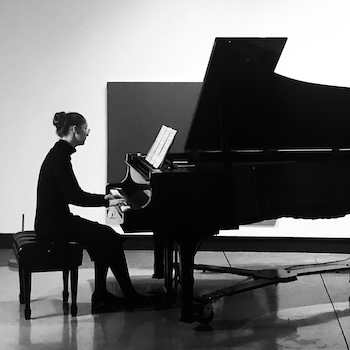
Kitty Lamarr is an alumna of Wilfrid Laurier University’s Master of Music Therapy program and the founding Coordinator of the Creative Therapy and Mental Health Program at Langs Community Health Centre/Youth Wellness Hub Ontario (Cambridge), where she leads music and creative psychotherapy programming across both organizations. In collaboration with Dr. Damien Kogutek, her research pioneers a novel methodology for tracking group musical output using MIDI drum circles. Her work, particularly in pediatric care, is recognized with multiple awards, including the Music Therapy Association of Ontario’s Student Recognition Award.
This study explores how drum circles can help build social connections and improve communication in Waterloo Region communities.
Kitty Lamarr is an alumna of Wilfrid Laurier University’s Master of Music Therapy program and the founding Coordinator of the Creative Therapy and Mental Health Program at Langs Community Health Centre/Youth Wellness Hub Ontario (Cambridge), where she leads music and creative psychotherapy programming across both organizations. In collaboration with Dr. Damien Kogutek, her research pioneers a novel methodology for tracking group musical output using MIDI drum circles. Her work, particularly in pediatric care, is recognized with multiple awards, including the Music Therapy Association of Ontario’s Student Recognition Award.
This pilot study explores the feasibility of using MIDI drum circles to track changes in self-efficacy for students enrolled in alternative education programs.

Alexandra Wrigley is a recent graduate of the Master of Music Therapy program at Wilfrid Laurier University in Waterloo, Ontario. Originally trained as a music teacher, Alexandra holds bachelor's degrees in Music and Education, and a MA in Music with a specialty in Education. Her background in education informs her music therapy practice, where she is inspired to use music as a tool for connection and self-expression. Alexandra intends to pursue a psychotherapy designation to integrate music-based interventions into mental health care. Lifelong learning and a passion for research motivate her plans to pursue doctoral studies in the future.
This project explores participants’ experiences of engaging in an improvised drumming exercise used within an IAMT-based Parkinson’s disease assessment study. Drawing on qualitative interviews conducted prior to quantitative testing, the study examines how individuals with and without Parkinson’s disease perceived the music-making process while playing electronic drums alongside live piano accompaniment. The analysis focuses on participants’ emotional, cognitive, and relational responses to the activity. Findings aim to deepen understanding of how such musical tasks are experienced and how these experiences may inform the development of music-based assessment tools in neurological contexts.